For adults, normal cholesterol levels are a total cholesterol of 5.2 mmol/L or less, triglycerides of 1.7 mmol/L or less, and HDL ("good" cholesterol) of at least 1.0 mmol/L for men and 1.2 mmol/L for women. There is no single normal number for LDL ("bad" cholesterol). The target depends on your heart risk: below 3.0 if your risk is low, and 1.4 or less if you already have heart disease or have had a stroke. High cholesterol has no symptoms, so only a blood test can tell you.
The numbers, from the Malaysian guideline
A cholesterol test (lipid profile) gives four readings. Doctors in Malaysia use these cut-offs from the 2023 national guideline on dyslipidaemia (abnormal blood fats):
| Test (mmol/L) | Good | Needs attention | Cut-off in mg/dL |
|---|---|---|---|
| Total cholesterol | 5.2 or less | above 5.2 | 201 |
| Triglycerides | 1.7 or less | above 1.7 | 151 |
| HDL ("good" cholesterol) | |||
| Men | 1.0 or higher | below 1.0 | 39 |
| Women | 1.2 or higher | below 1.2 | 46 |
| LDL ("bad" cholesterol) | |||
| Everyone | depends on your heart risk | see the next table | see below |
The guideline says heart risk rises steadily with cholesterol, with no true line between normal and abnormal. To convert mg/dL to mmol/L, divide cholesterol by 38.67 and triglycerides by 88.57.
What are good and bad cholesterol (HDL and LDL)?
- LDL ("bad" cholesterol) is the main cause of fatty build-up (plaque) in the blood vessels. The lower your LDL, the lower your risk of heart attack and stroke.
- HDL ("good" cholesterol) that is low raises heart risk, especially with high LDL and triglycerides. Low HDL is more common in Asians, and in people who are inactive or obese.
- Triglycerides are a blood fat that rises after you eat, and runs higher with poorly controlled diabetes or alcohol.
- Total cholesterol is all the cholesterol in your blood, LDL and HDL included.
What is a normal cholesterol level after 40?
The cut-offs above are the same for every adult. What changes is your LDL target, which depends on your 10-year chance of heart disease or stroke, worked out from your age, sex, cholesterol, blood pressure, smoking and diabetes. Age is a major risk factor, so your risk climbs with age even if your cholesterol stays the same.
| Risk level | Who | LDL target (mmol/L) |
|---|---|---|
| Low | 10-year risk below 10% | below 3.0 |
| Intermediate | Risk of 10% to 20%, or diabetes for under 10 years, age under 50, no other risk factors | below 2.6 |
| High | Risk above 20%, diabetes for over 10 years plus one other risk factor, or moderate kidney disease | 1.8 or less, and down over 50% |
| Very high | Heart disease, a past stroke, diabetes with organ damage or several other risk factors, or severe kidney disease | 1.4 or less, and down over 50% |
| Repeat events | Another heart attack or stroke within 2 years despite an LDL below 1.4 | below 1.0 |
"Down over 50%" is measured from your LDL before treatment. In mg/dL, 3.0 is 116, 2.6 is 101, 1.8 is 70 and 1.4 is 54.
Why so many people do not know they have it
High cholesterol has no symptoms, and the Malaysian guideline notes it is often found only at a first heart attack or stroke. The National Health and Morbidity Survey 2023 found that 33.3% of Malaysian adults have high cholesterol, and 18.1% of all adults have it without knowing. That is more than half of everyone with high cholesterol.
The Malaysian guideline advises a cholesterol test for:
- All adults over 30.
- Adults over 18 with diabetes, high blood pressure, a large waist or kidney disease, smokers, and anyone whose father or brother had heart disease before 55 (mother or sister before 65).
- Good results: repeat every 3 years. High or very high risk: every year.
High cholesterol does not cause an emergency by itself. The danger is a heart attack or stroke.
Call 999 or go to a hospital emergency department if you or someone with you has:
- chest pain that feels crushing or squeezing, which may spread to the arm, neck or jaw
- shortness of breath, sweating, or nausea and vomiting with chest pain
- a face that droops on one side, or trouble smiling
- weakness or numbness in one arm, so both arms cannot be lifted
- slurred speech or confusion, sudden blurred vision, or a severe headache
Do not drive yourself to hospital. If stroke signs go away after a few minutes, still get help straight away.
Do you need to fast before a cholesterol test?
The 2023 Malaysian guideline accepts a non-fasting test, because the difference in readings is small. Fasting is preferred if your non-fasting triglycerides are above 4.5 mmol/L, or if a blood fat problem runs in your family.
At our clinic, we ask you to fast for 10 to 12 hours before a cholesterol test (plain water is fine), because triglycerides change with meals and the LDL on your report is usually calculated from your triglyceride reading. The same fast covers a fasting blood sugar test.
Signs of inherited high cholesterol (FH)
Familial hypercholesterolaemia (FH) is an inherited condition that keeps LDL very high from a young age, and heart disease can start as early as the twenties. Tell the doctor if you have:
- a close relative who had an early heart attack or stroke, or who has FH
- firm lumps on the Achilles tendon (back of the ankle) or over the knuckles
- yellow patches on the eyelids, usually near the inner corner (xanthelasma)
- a greyish-white ring at the edge of the coloured part of the eye (corneal arcus)
If your cholesterol is high
These changes help everyone, whether or not you need medicine:
- Cut saturated fat. Santan (coconut milk), coconut oil, palm oil, ghee, butter and fatty meat are high in it. Have santan dishes only now and then, remove chicken skin, and cook with sunflower, canola or corn oil.
- Fewer fried foods and fried kuih. Oil heated again and again can turn into trans fat, the fat that harms the heart most. Margarine, biscuits and cakes also contain it. Choose steamed kuih.
- Processed meat and organ meat only now and then. Sausages, burgers and nuggets are high in fat, and liver is high in cholesterol, though cholesterol in food has only a small effect for many people because the body makes most of its own.
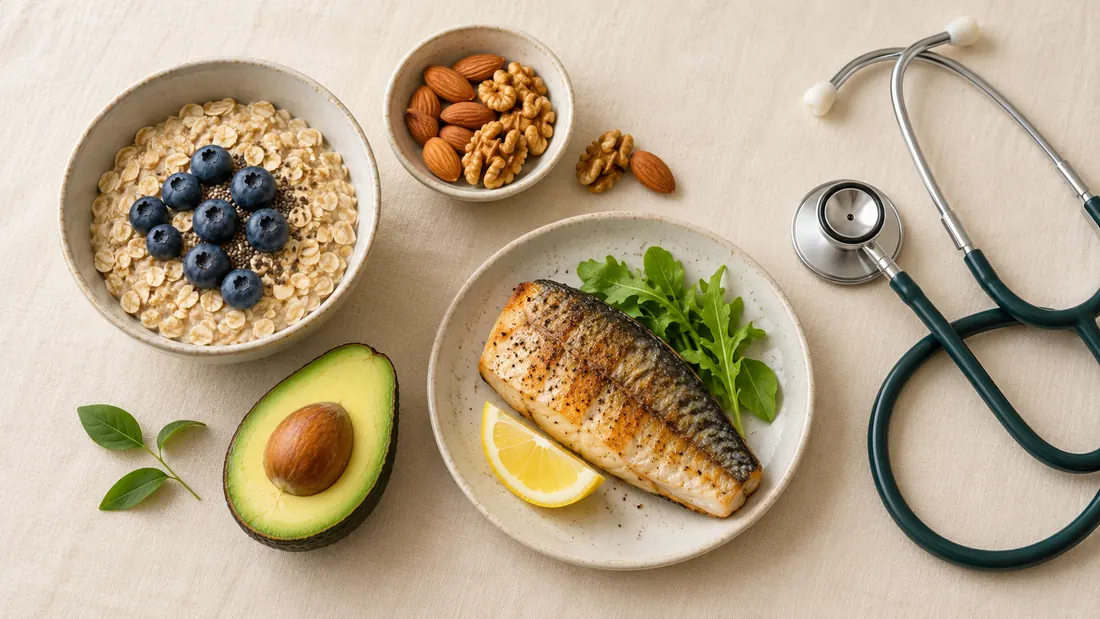
- Add fish, nuts and whole grains. Have fish at least twice a week, such as ikan kembung (mackerel), siakap (sea bass) or patin, grilled or boiled. Half a cup to a cup of nuts a day can lower LDL, though nuts are high in calories. Oats, brown rice and lentils add fibre, and tofu can replace some of your meat.
- Move for 150 to 300 minutes a week, such as a 30-minute brisk walk five days a week.
- Lose 5% to 10% of your weight if you are overweight, and aim for a waist below 90 cm (men) or 80 cm (women).
- Stop smoking, and avoid or limit alcohol. Heart risk starts to fall within 6 months of quitting smoking.
Many people also need a statin. The doctor decides from your overall risk, including age, blood pressure, blood sugar, smoking and family history. Statins are taken every day, often for life, with a repeat test 1 to 3 months after starting and then every 6 to 12 months. Do not stop when the numbers look good: the medicine is what keeps them there. Tell the doctor if you are pregnant or breastfeeding.
Walk in for a cholesterol test
We do cholesterol tests (lipid profile) in the clinic, day or night, and look after long-term care of high cholesterol, high blood pressure and diabetes. Fast for 10 to 12 hours before the test (plain water is fine).
WhatsApp usor call 088-239 393See our cholesterol test and other blood tests.
Questions people ask
What is a normal cholesterol level for someone over 40?
The same as for any adult: total cholesterol of 5.2 mmol/L or less, triglycerides of 1.7 or less, and HDL of 1.0 or higher (men) or 1.2 or higher (women). Your LDL target depends on your heart risk, and that risk rises with age.
What is total cholesterol?
All the cholesterol in your blood, LDL and HDL included. A reading of 5.2 mmol/L or less is good, but the doctor always reads it alongside your LDL, HDL and triglycerides.
What are the signs of high cholesterol?
Usually there are none, which is why it has to be checked with a blood test. Lumps on the Achilles tendon or yellow patches on the eyelids can point to inherited high cholesterol (FH).
What causes high cholesterol?
Usually a mix of genes and lifestyle: a diet high in saturated fat, too little activity and extra weight. An underactive thyroid, kidney disease, diabetes, alcohol and steroid medicines can also raise it.

A general practitioner clinic for the whole family, from babies to grandparents. A doctor and a nurse are on duty every hour of every day, and you can walk in without an appointment. Meet the team
Sources
- Clinical Practice Guidelines: Management of Dyslipidaemia, 6th edition (2023), Ministry of Health Malaysia, Academy of Medicine of Malaysia and National Heart Association of Malaysia
- National Health and Morbidity Survey 2023 fact sheet, Institute for Public Health
- NHS: Facts about fat
- NHS: Heart attack, symptoms
- NHS: Symptoms of a stroke
This article is general health information and does not replace a visit to the doctor. If you are worried about yourself or your child, see a doctor.